David Acord on ‘Behemoth!’: syncopated footsteps, and 40 percent fewer lasers
The “Rogue One” and “Andor” sound designer accepted the Denver Film Festial 2026 Excellence in Sound Design award in person, then explained how he mixed music and effects on Tony Gilroy’s Pedro Pascal drama.
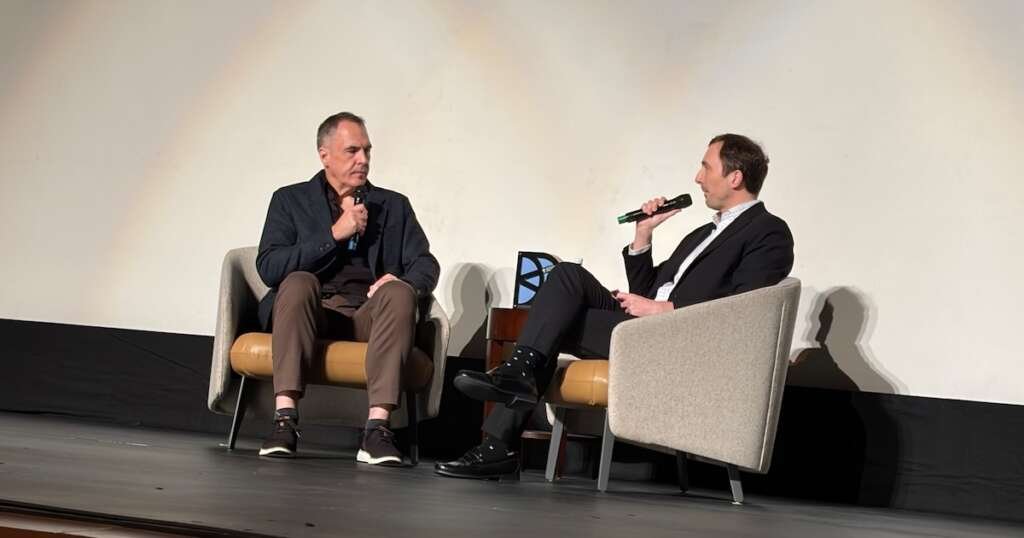
Sound designer and re-recording mixer David Acord appeared in person Oct. 24 to receive the 2026 Excellence in Sound Design award. He spoke at the Denver Center’s Ellie Caulkins Opera House following a screening of Tony Gilroy’s “Behemoth!,” starring Pedro Pascal.
Acord, whose credits include “Rogue One” and “Andor,” is best known for big science-fiction and genre projects. He described how a dialogue-heavy, human-scale drama pulled him out of his comfort zone, from syncing footsteps to the score to rebuilding the acoustics of a funeral from production recordings.
Acord also gave a look at how sound, music and picture come together over months of cuts, why nine composers did not turn the film into a kitchen full of cooks, and what moviegoers might catch on a second viewing. What follows is an edited version of the conversation with Matthew Campbell, Artistic Director of Denver Film.
The score and the sound effects dance together in this film. How did you approach that?
It’s a properly scored, mixed track, and there are depths and flows to it because it’s a playful film. The lead character isn’t really running for his life. I mean, he kind of is, and it’s terrifying, but you can’t be full war the whole time. We have to dance, bob and weave with the action on the screen. We do some fun things, like syncopating the sound of her (Olivia Wilde’s character, Carol) heels, her footsteps, with the music. If you’re eagle-eyed, you’ll notice some of the footsteps aren’t exactly in sync with her feet, because we were trying to sync the effects to the music. You don’t really notice, because you don’t really see her feet. The click of her heels goes with the beat of the music when she’s chasing him around.
Was that sound recorded for the film, or did you produce it afterward?
That’s Foley. For those who don’t know, Foley is the set of sound effects we recreate in post-production that are tied to a performance: footsteps, picking up an object, handling a microphone. Sound effects are different. A car crash or a car driving by, things that aren’t necessarily tied to an actor’s performance.
On the flip side, the funeral scene is about the absence of sound. How did you approach something that minimalist?
The little mini performances that occur at the funeral are all production recordings, captured on the spot when they filmed it. They aren’t re-recordings. We had mono and stereo tracks for those, not re-recorded 5.1 tracks to play with. So the trick was making sure they all sound like they’re in the same space.
The production mixer, Steve Morrow, who’s amazing, recorded what are called IRs, or impulse responses. You clap your hands or make some loud transient sound in a space and record it. Then you can plug that capture into your reverb as an algorithm, so you’ve essentially saved that space and can recall it acoustically wherever you need it. We did that for a lot of things. We did the same with the scoring stages: if we wanted to use a re-recorded instrument but make it sound like it was on that stage with the other instruments, we used those IRs.
How much of your work happens before the sound booth? Pedro Pascal learned the cello in six months, for example. Are you working with the actors, or mostly with Tony from the script?
Tony let me read the script probably a year before I started on it, which was maybe eight months before they filmed. You start getting ideas about how things will sound and what you might need to collect in terms of sound effects. It’s a little early to present them at that point, since nothing has been filmed. Once they start filming and assembling scenes, and you start seeing things on the screen, those ideas get more specific. You bounce them off Tony, or more often the picture editor, and you start coming up with concepts. It really solidifies when we get to the mix.
What does that process look like as the picture is cut together?
They work toward what’s called the director’s cut or an assembly cut, which is just the initial cut of everything they shot. After that it’s about whittling it down and fine-tuning it. With each iteration of the cut, we’re cutting sound effects, cutting Foley, re-recording dialogue, which we call ADR, and the music is being scored. Demos become actual score. It’s fine-tuning with finer and finer grains of sandpaper until you get to the polish at the very end. It’s a lot of back and forth, a lot of show and tell, until the last few weeks of the final mix, when it’s just: here’s our product.
What was the most challenging and most rewarding part for you on this film?
I mixed music and sound effects on this. Normally with two re-recording mixers, one takes dialogue and music and one takes sound effects. Here I wanted to take effects and music, because I wanted to syncopate some of the effects with some of the music. It’s also such a dialogue-heavy movie that I wanted someone else to handle dialogue without also juggling music. Chris Scarabosio, my co-designer on “Rogue One,” came with me, and we’ve mixed some other Paul Thomas Anderson movies together. He’s a good friend, so we have a shorthand.
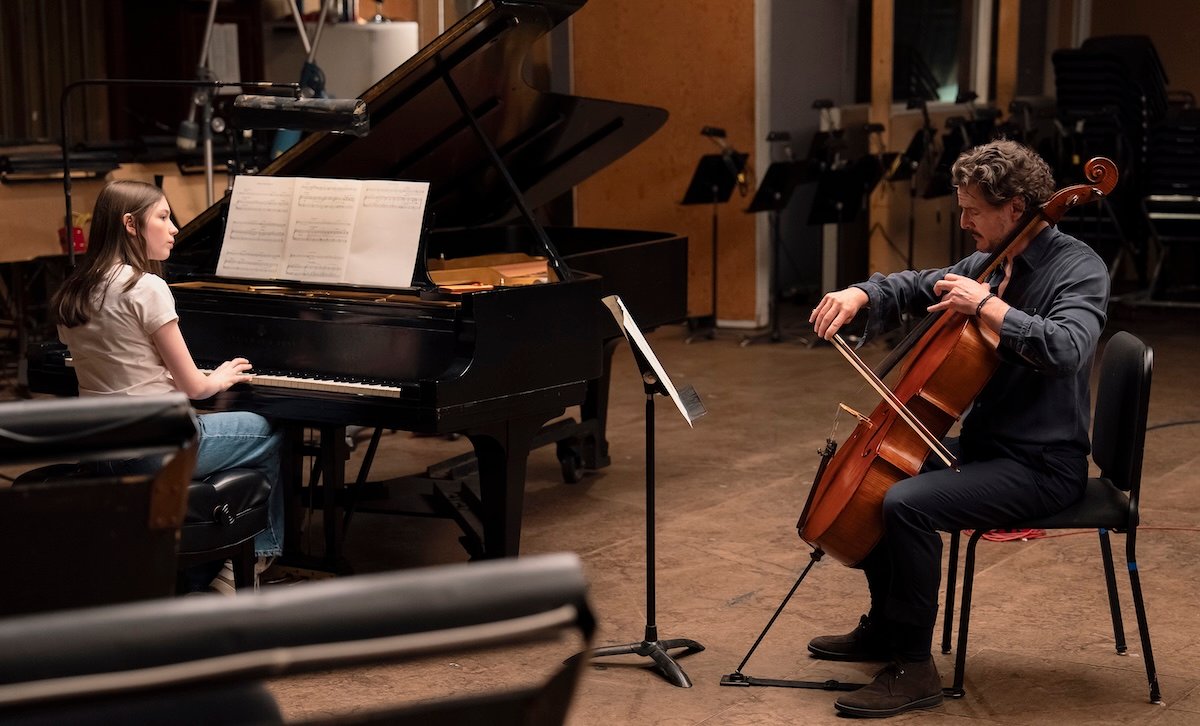
Alexa Swinton and Pedro Pascal in ‘Behemoth!’ BEHEMOTH! | Photo: Justin Lubin/Searchlight Pictures. Courtesy of Searchlight Pictures.
I’m particularly a sound effects guy. I work on a lot of big sci-fi and make a lot of spaceships and lasers and monsters. (Laughing) This movie has about 40 percent fewer lasers than I’m used to. Getting to mix the music was way outside my comfort zone, and I’m just proud we got it through in one piece. I’m proud of what we did.
The film has nine composers. Was that a lot of cooks in the kitchen?
Tony very shrewdly assembled this group of nine composers, called the Behemoth Collective. There are a lot of fake movies within the movie, and he wanted each one to have its own composer, in a meta way. I think they all trusted Tony to hire the right people and pull it together. We had a great music supervisor wrangling everything, and the composers weren’t involved at a granular level in the final mix. We got occasional drop-ins. A couple came to the stage to listen for a day. But nobody was hovering over the process. Thank God for that.
Your filmography is mostly genre work, and this is a human drama. What drew you to it?
It’s definitely a challenge, and it’s what draws me to movies like this. I do so much big sci-fi that it’s fun to step outside the box and create sound for something that isn’t so obviously in need of sound design, the way animation is. I’ve only had that a few times in my career. “Andor” was an interesting hybrid. It’s a science fiction show, but Tony insisted everything be grounded, so sound effects had to feel real, diegetic and tactile. Taking some of that technique and applying it here was helpful, and it guided me into his wheelhouse a little bit.
If sound design is done well, audiences don’t notice it. What would you hope people take from the film’s sound after seeing it?
I think the question is also part of the answer. You can watch a movie and not notice the sound design, and in the same way, you notice it by not noticing it. This is a perfect example: sound design that isn’t obvious, but isn’t invisible either. Maybe you’ll catch something like the ticking of the grandfather clock being in line with the music. There are little bits and pieces we snuck in and played with. On a second or third viewing you might have more fun with them and go, “Okay, I see what you did there.”
Acord returns to Tattered Cover on Colfax at 11:30 a.m. Oct. 25 for a full hour-long conversation, with more on “Star Wars” and the history of his career.