How ‘Art Not as Usual’ found its story in 150 hours of footage
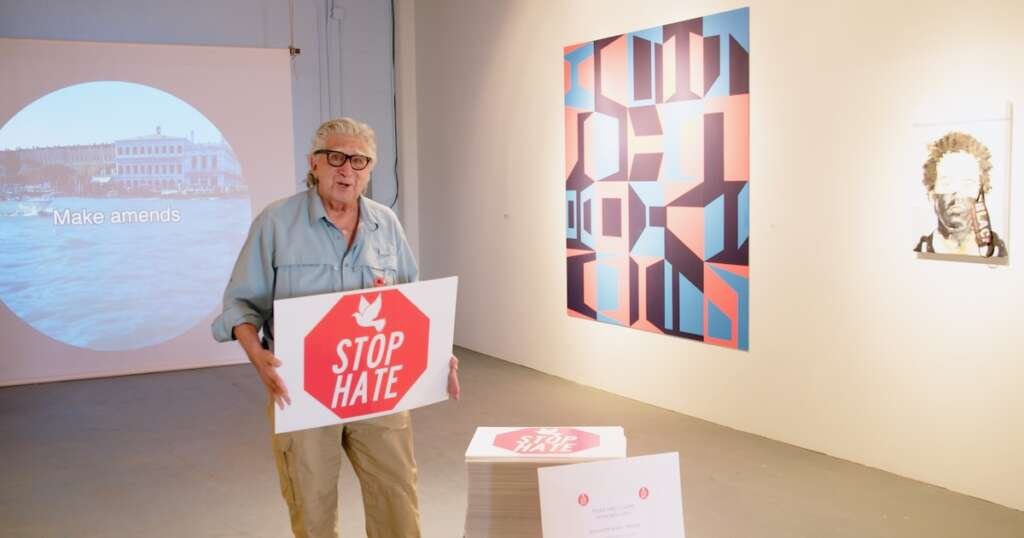
"Art Not as Usual" premieres Oct. 24 at the Denver Film Festival, followed by a Boulder screening and discussion Dec. 13.
‘Art Not as Usual’ premieres Oct. 24 at the Denver Film Festival, followed by a Boulder screening and discussion Dec. 13.
The Artnauts have spent 30 years bringing contemporary art to international communities. Filmmaker Annie Eastman captured roughly 150 hours of footage of the group and then was tasked with whittling it down to a 60-minute documentary.
“Which is kind of an unconventional length for film festivals, kind of too short to really be seen as a feature,” Eastman admits. “But we had some intentionality around that. We see this film as something that we want it to be screened in classrooms, galleries, churches and conferences, you know, events where people watch it together in a room, followed by a discussion.”
Founded at CU Boulder in 1996, the international collective has presented 256 exhibitions around the world, using art to encourage dialogue across cultural divides. Eastman initially envisioned an observational documentary following the artists’ contemporary work. At one point, she even considered making the film without a single talking-head interview.
“Structurally, the other challenge with the film is that it’s a collective of 70 people, so how do we represent that without attaching ourselves too solidly to just a couple of characters?” Eastman said. “There was that tension between how do we make this intimate, exploring a few people’s experience of why they do this and how it impacts them versus how do we tell a story of a collective voice?”
The result is “Art Not as Usual,” a 60-minute documentary making its world premiere Saturday, Oct. 24, at 10:30 a.m. at the MCA Holiday Theater during the 49th Denver Film Festival. The Colorado Spotlight screening includes a Q&A with Eastman, producers Martha Russo and Pamela Beverly-Quigley, and Artnauts founders George Rivera and Beth Krensky.
Filmed during exhibitions in 2024 and 2025, “Art Not as Usual” follows the collective’s work in Brazil, Rwanda, Colombia, Northern Ireland and Bosnia and Herzegovina while tracing its origins and Rivera’s experiences with racism growing up in Texas.
“I would usually get to the location a couple days ahead of time and stay for a day or two after,” Eastman said. “On almost all the trips, I had my Blackmagic camera with a shotgun mic so I could be a scrappy, one-woman band filmmaker, just following things that seemed interesting.”
Finding a story in the footage
Russo, president of the Artnauts board, approached Eastman around the collective’s 25th anniversary in 2021, hoping to make a film for its 30th. Their first meeting took place over Zoom during the COVID-19 pandemic.
“We need to find somebody to capture George,” Russo recalls thinking. “And I’ll never forget that day when Annie went to George’s house and spent the entire day interviewing him, and I just had a huge sense of relief that ‘We’ve got it. We’ve got George’s story.'”
“Art Not as Usual” soon expanded beyond a biographical portrait. During exhibitions in 2024 and 2025, Eastman amassed about 32 terabytes of footage, which she estimates at 150 hours. In each location, she hired a local crew for about three days, then gathered additional material herself with a small camera and microphones.
“It’s hard to know when things are going to happen or what things are actually going to be interesting,” Eastman said.
The editing was even more demanding. Eastman had to weave together the histories of the places the Artnauts visited, the collective’s backstory and the work happening in front of her camera. She also struggled with how much artwork to show in “Art Not as Usual.”
“Actually, what makes this compelling is how much the actual, tangible art is not actually the center focus of what the Artnauts do,” she said. “It’s the spirit of it; it’s the ritual of it.”
Learning to make a movie together
Russo and Beverly-Quigley, both Artnauts, became producers of “Art Not as Usual” almost by accident. Neither had filmmaking experience. Russo helped organize shoots and relationships with local crews; Beverly-Quigley helped raise money and select artwork from decades of exhibitions.
A trained graphic designer, Beverly-Quigley initially wanted the artwork displayed against black backgrounds. Eastman explained that in a dark theater, black can disappear rather than make an image pop.
“Just learning things along the way, and watching Annie’s process has been really a gift,” Beverly-Quigley said.
After the Denver premiere, “Art Not as Usual” will screen in Boulder on Sunday, Dec. 13, at eTown Hall, 1535 Spruce St. Doors open at 6 p.m., the film begins at 7 p.m., and a panel discussion follows at 8 p.m. Additional screenings are being planned in communities connected to the Artnauts’ work, including international locations featured in the documentary.
Eastman says premiering in Colorado, near the collective’s birthplace, gives the yearslong project a fitting first audience. The timing has also taken on greater urgency following concerning news about Rivera’s health.
“We were a very late submission,” Eastman said. “We did get some bad news about George’s health, and that made the impetus to premiere even more urgent.”
Despite the late submission, the Denver Film Festival accepted “Art Not as Usual,” giving the Artnauts an opportunity to celebrate their founder’s legacy with a hometown audience.
“It’s the perfect place and the perfect time for us,” Eastman said. “We feel very fortunate that they were able to accept this film because this is the time for the Artnauts right now, and this is the time for Dr. George Rivera. So it means everything to me that we are going to be doing this in our hometown with all the people we love.”