Review: ‘Growth of the Soil’ is a primal epic of land, love and the world that intrudes
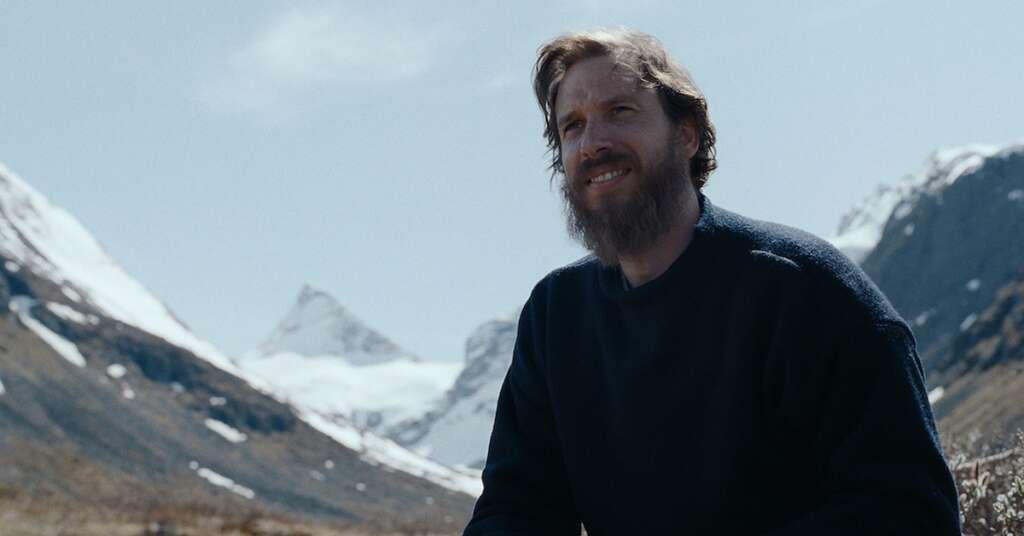
Hans Petter Moland’s adaptation of Knut Hamsun’s Nobel-winning novel follows a couple who build a life from nothing in the Norwegian wilderness, until the outside world arrives.
The first scene of the Norwegian film “Growth of the Soil” tells us exactly what kind of environment we’ll spend the next 159 minutes in. Wind blows dry snow around as a pair of hands digs in the soil. The camera pulls back to reveal Isak, who brings the earth to his face to smell it.
Such an inhospitable-seeming place may not look like anyone’s idea of great farmland, but Isak sees promise and sets up his meager camp in this gorgeous, rocky, waterfall-heavy corner of Norway. We don’t know where he came from, anything about his past or what motivates him beyond mere survival.
Soon he is joined by an equally mysterious and solitary figure, Inger, a woman with a pronounced cleft lip, a fuzzy goat and apparently nowhere else to go other than one unidentified mission over the mountain. For a time, they inhabit a cold-weather Eden as lovers, partners and parents. Few words are spoken, but as they move past basic subsistence, complexity and language grow, weaving a tale of a relationship that must endure intense pressure.
Based on Knut Hamsun’s 1917 novel, which helped earn him the Nobel Prize in Literature, the film was adapted by Hans Petter Moland and Gard B. Eidsvold and is being screened in the U.S. for the first time at the Denver Film Festival. Moland’s depiction of the early days of Isak and Inger’s union is nothing short of primordial. At first, the illiterate couple have only a cleft in the rocks and an open fire to protect them from the howling winds of the Norwegian winter. They then build a crude hut from sticks and, as the story progresses, continually upgrade their homestead to include a wood-and-rock house, a barn, livestock, a small farm and eventually a copper mine.
Children come as well, and Inger sends Isak away each time she’s about to give birth to avoid the chance that he’ll see a newborn sharing her deformity. The first two boys are fine, but when the third child comes with a cleft lip, Inger takes a drastic action that changes everything.
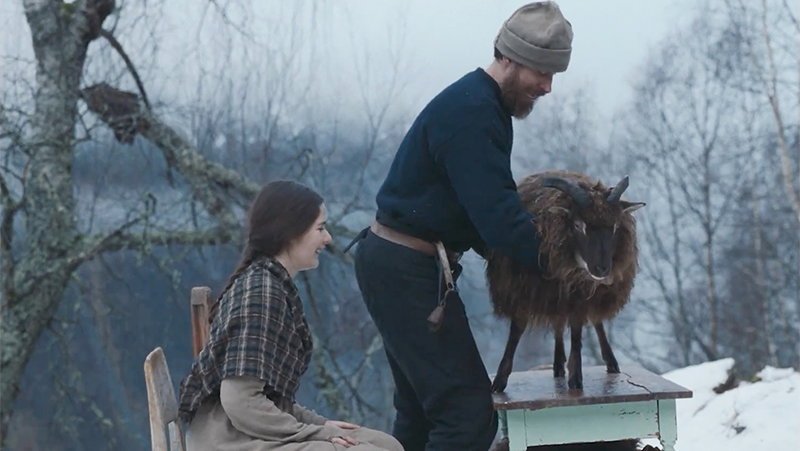
Asta Kamma August and Herbert Nordrum in ‘Growth of the Soil.’
The others
Cinematographer Oskar Dahlsbakken has a stunning canvas to work from in the uninhabited area of Norway where “Growth of the Soil” was filmed. The long shots of the landscape, particularly the cliffs where impossibly tall waterfalls cascade from above, suggest the impassive presence of the natural world as the human dramas unfold below.
It’s not long before “the others” appear in the insular world of Isak and Inger. A sheriff arrives to inform them that land can’t be claimed without a deed or tax payments. Later, a different sheriff comes to take Inger away to be punished for the crime against her newborn. In prison, she has another daughter, learns to become a seamstress and has an operation to repair her lip. When her sentence is up, she returns to Isak a completely different woman.
Moland unfolds the whole thing in a hyperrealistic, matter-of-fact fashion that makes “Growth of the Soil” feel like a book of the Old Testament. As the first man and first woman of this land, Nordrum and August are tremendous. At first they are wholly in love, with no other considerations beyond food and shelter, and we watch in vivid close-up as the world slowly but surely intrudes on their idyllic, if harsh, early years together. Isak struggles to adapt, at one point revolting against Inger’s manual sewing machine as a symbol of the modern world tearing at his family.
In the end, following a series of poor decisions on both their parts, Inger apologizes, saying she did not act as she should have toward her husband.
“No one is as they should be,” replies Isak with a kiss, neatly summing up the whole problem with humanity. It’s the kind of terse, profound statement that could easily serve as the film’s logline.