‘The First’ warns America: Use your rights or lose them
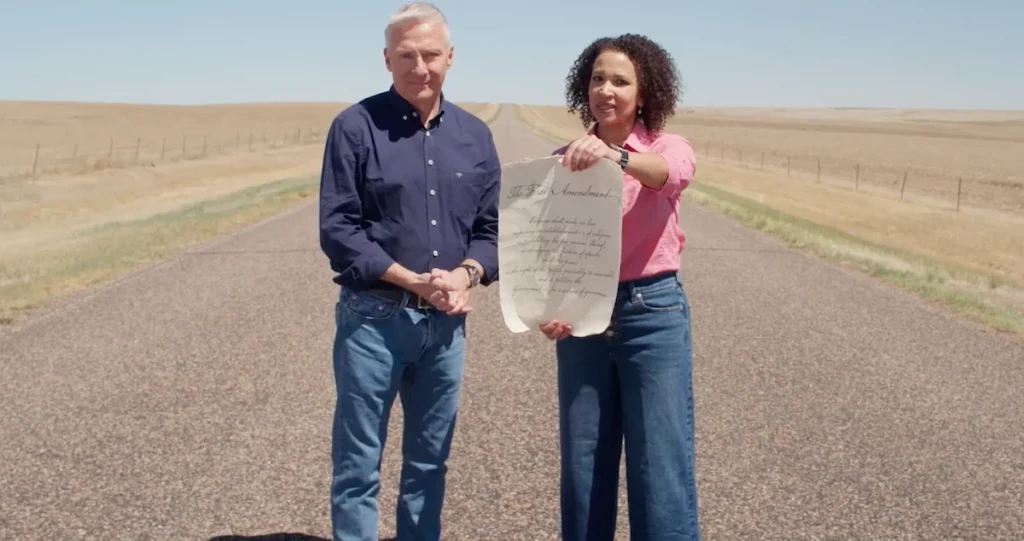
Director Brian Malone and host Bazi Kanani discuss the Colorado-made PBS documentary "The First" about America's First Amendment.
Bazi Kanani makes her living exercising the First Amendment. But when the Colorado Public Radio journalist agreed to co-host a documentary about it, she discovered how much she’d forgotten since high school civics class.
“Journalists are very aware that this amendment protects our ability to do our job,” she said. “But, just like most people, it had been a really long time since high school civics class. It had been a long time since I’d actually, like, taken out the Bill of Rights and said, ‘Let me read the detail of this.’ There’s a lot of history about the First Amendment that was really fascinating to learn.”
That curiosity helped shape “The First: Free Speech At The Crossroads,” a Colorado-made documentary examining how Americans have spent more than two centuries fighting over the freedoms enshrined in their Constitution.
“A lot of people, I think vaguely, know that it’s a free country, so that means I can say what I want,” Kanani said. “This is a right that is an important value to us, and we take it for granted that we have it without sometimes stopping to really understand.”
Directed by Castle Rock filmmaker Brian Malone and co-hosted by Kanani and NBC News correspondent Tom Costello, the 87-minute film premiered Oct. 1 and is available to stream on PBS.org and the PBS app, with broadcasts on participating PBS stations.
The documentary traces the First Amendment’s contentious history, beginning with the Alien and Sedition Acts of 1798, which allowed the government to prosecute its critics just years after the Bill of Rights was ratified. It follows the legal battles that gradually expanded constitutional protections, including landmark Supreme Court decisions involving investigative journalism and student protests.
Kanani was particularly fascinated by the connection between the civil rights movement and New York Times v. Sullivan, the 1964 ruling that strengthened protections for journalists reporting critically on public officials.
“A court case that came out of that movement actually ended up leading to a new era in investigative journalism,” she said.
Through interviews with former newspaper editors Martin Baron and Dean Baquet, former CNN correspondent Barbara Starr and student protester Mary Beth Tinker, the documentary explores how those legal decisions continue to shape American life. The experience left Kanani with a deeper appreciation for the founders’ foresight and the generations of Americans who have fought to define the freedoms they established.
“It was really fascinating to think about how clever the founders had to be to understand that they were writing an amendment that would be challenged,” she said. “There would always be some tension here, and that this would always be something that had to be defended, and maybe even over many years had to be further refined.”
Colorado project goes national
Malone’s interest in press freedom predates “The First.” About two years ago, he launched Free Press Free Country, a civic education initiative aimed at explaining why independent journalism matters. Its Colorado-focused documentary “Truth Be Told,” produced in partnership with 9NEWS, led him toward a bigger question: What does the First Amendment actually protect, and how did those protections develop?
“I thought it was time to remind Americans what the First Amendment is and what the First Amendment isn’t,” Malone said.
Work began in November 2025. By early 2026, Malone had assembled a historical framework and was looking for journalists who could guide viewers through it. Kanani, who appeared in “Truth Be Told,” was an obvious candidate. Costello seemed a longer shot, despite having worked with Malone at Denver’s 9NEWS decades earlier.
Former 9NEWS news director and “The First” producer Tim Ryan reached out to Costello, who agreed to participate. Malone was equally surprised when NBC granted permission for its correspondent to work on an independent production.
“There’s no way Tom would do this,” Malone remembered thinking. “But, you know, ‘What the hell? Ask him.’ So Tim asked him, and he said, ‘Sure. How soon can I start?’ and it was really crazy that he said yes, and it was even crazier that NBC gave him permission. That was bizarre that this major network allowed Tom to do an independent film with this little guy from Castle Rock, Colorado. But I guess it says something about the project.”
Kanani and Costello helped refine the script and interview choices. Filming took the team from Colorado to Washington, D.C., Philadelphia, Boston, Montgomery, Alabama, and other places central to the First Amendment’s history. Rocky Mountain PBS, a longtime partner of Malone’s, serves as the presenting station, helping make the independently produced film available nationally.
“Rocky Mountain PBS has been a great distribution partner for me for over 20 years,” Malone said. “They’re the regional endorser of the program that gives it the stamp of approval that says, ‘Hey, we stand behind this program,’ and gives it kind of a credibility.”
A history that refused to stay in the past
The documentary’s subject kept intruding on its production. Malone said he had already delivered the finished film to PBS when new restrictions on Pentagon reporters prompted him to pull it back for substantial last-minute edits.
“I had to do some surgery, major surgery on the film,” he said.
The scramble made his point particularly urgent: Constitutional rights are continually contested, and the disputes are unfolding while Americans go about their lives.
“It is like a muscle,” Malone said. “You got to use it or lose it.”
He hopes “The First” will become a starting point for those conversations beyond television. He has arranged screenings and discussions with roughly half a dozen colleges, most in Colorado.
Although the release has consumed his attention, he is considering another civics documentary, this time about the Electoral College and whether it still serves its intended purpose.
“What the hell is it? And why do we have it?” Malone asked. “And what purpose does it serve today? Is it still relevant? Is it time to hit reset? That is kind of one of the things that I think would be right in our sweet spot.”
Kanani hopes viewers leave with a more basic understanding: Putting a freedom into the Constitution does not guarantee its survival.
“Just because it’s on the Constitution doesn’t guarantee that we will always and forever have this right,” she said. “It is something that will constantly have to be defended, and I worry that we won’t do that well if we don’t actually understand it and appreciate it.”