Denver Film leaders discuss its history, Sundance, local filmmakers and the future of Colorado’s growing film festival scene.
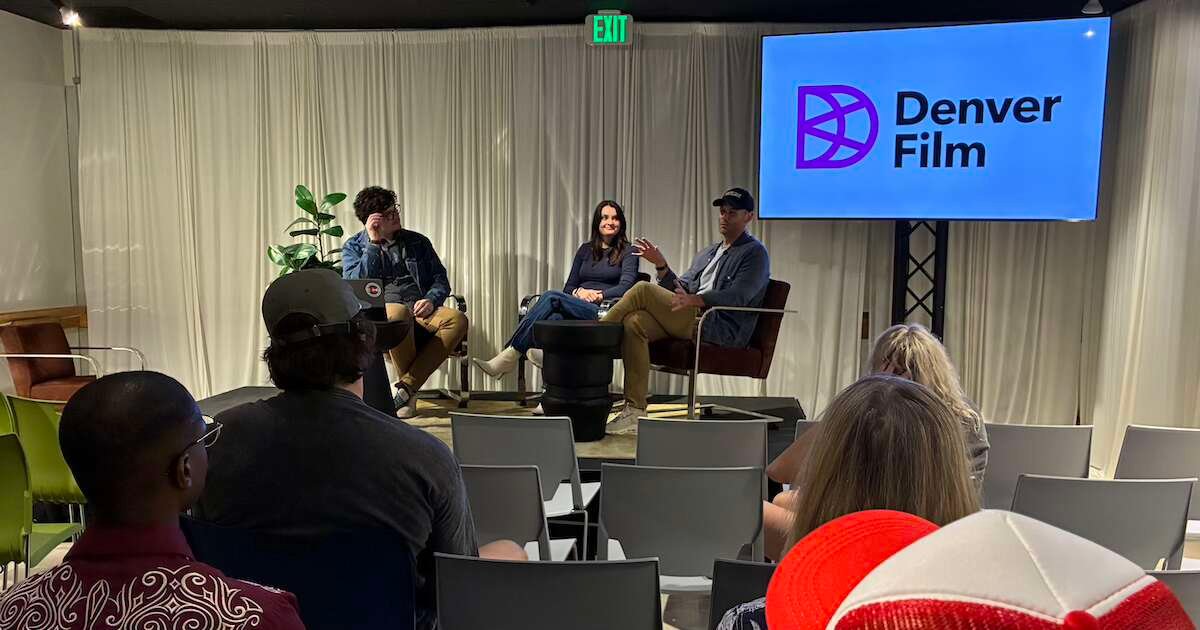
25 people gathered at Writer Square at 10 a.m. on Saturday to talk about the future of film in Colorado at the exact moment Denver Film unveiled the schedule for its 49th festival.
While audiences elsewhere were scrolling through the newly announced lineup, Denver Film CEO Kevin Smith and Festival Producer Alaina Campbell were looking beyond this year’s films to a bigger question: What role should a nearly 50-year-old regional film organization play as Colorado becomes an increasingly prominent destination for filmmakers and moviegoers?
During the Oct. 3 State of Film panel, part of Cinema Toast House’s inaugural event, Smith and Campbell discussed Denver Film’s evolution, the arrival of Sundance in Boulder, the growth of Colorado’s festival ecosystem and their efforts to build stronger connections between local filmmakers and the audiences who support them.
For Smith, that community focus increasingly defines what separates Denver from major industry festivals.
“There are regional festivals like ours or Chicago or New York, which are big festivals, but they’re really for the community,” Smith said. “And then there are festivals like Sundance and Cannes and Toronto, and those are marketplace industry festivals.”
At those larger festivals, much of the activity revolves around buying, selling and positioning films within the industry. Denver Film’s goal, Smith said, is different.
“Our goal is really to support the region,” he said. “Our goal is really to have people in Denver, the Denver metro and around the state be able to have a great film festival experience.”
A festival that keeps changing
Denver Film Festival began in 1978 as a 10-day May event centered downtown. Since then, it has bounced between venues across the city, expanded into a year-round organization and eventually settled into the Sie FilmCenter as its permanent home.
Its scale also changed dramatically. Before the COVID-19 pandemic, Smith said, the festival sometimes presented roughly 350 films across six venues while also producing a large virtual reality, augmented reality and immersive exhibition.
“That is way too many,” he said.
Post-pandemic audience shifts prompted Denver Film to reconsider both the size of the festival and where it should happen. New screening options at Denver Botanic Gardens, the Denver Museum of Nature & Science and other venues allowed the organization to move beyond the downtown-heavy model it had maintained for years.
Campbell said those partnerships begin taking shape almost immediately after each festival ends. Conversations with venues typically start in January, months before the schedule is finalized.
“We really try to transform all of these spaces,” Campbell said. “And it’s a lot of work, but we’ve been going back to a lot of the same venues every year, which I think has built really strong parentships and just made it really smooth operations.”
At the same time, Denver Film has recently refocused attention on the Sie FilmCenter as the festival’s central gathering place.
Smith said he wants audiences to feel comfortable spending an entire day there — watching films, hanging out in the lounge or talking with other moviegoers — rather than attending a screening and immediately heading home.
“When I go to Telluride, you’re just in the festival the whole time you’re there,” Smith said. “If we can get to that point where people feel like, even though it is not a destination festival, it’s your hometown festival, and you can just be there the entire time.”
Sundance adds another piece to Colorado’s film ecosystem
Sundance’s move to Boulder in 2027 could easily be viewed as competition for Colorado’s existing festivals. Smith does not see it that way. He said Denver Film has maintained a long relationship with Sundance and that he was involved in conversations surrounding the move before Boulder was selected.
“We are nothing but excited,” Smith said.
Rather than diminishing Colorado’s existing festivals, he hopes Sundance will place a larger spotlight on an ecosystem that already includes Telluride Film Festival, Aspen Shortsfest, Boulder International Film Festival, Breck Film Fest, Crested Butte Film Festival, SeriesFest and numerous smaller specialty festivals.
“You really can just do festival hopping throughout the entire year and see a whole new slate of films and experiences at each one of them,” Smith said. “What’s been really cool is with Sundance coming in, we’ve had this opportunity to really bridge all the work that we’re doing and start applying more ways to collaborate and support each other.”
Denver Film itself operates several specialty festivals and programs, including CinemaQ, Women+Film Festival, Denver Silent Film Festival and the Colorado Dragon Boat Film Festival, along with Film on the Rocks and Sunset Cinema.
Those smaller programs also reflect a philosophical shift within Denver Film. Smith recalled that when he joined the organization, then known as the Denver Film Society, he felt its identity could seem closed off.
One of his first moves as CEO was dropping “Society” from the name.
“I felt like the vibe was super exclusive,” he said. “I was like, ‘That is not how you build community.'”
That same philosophy now shapes how Denver Film approaches programming. Rather than assuming the organization knows what audiences should see, Smith said programs increasingly grow through conversations with the communities they intend to serve.
He pointed to the Colorado Dragon Boat Film Festival, which grew from roughly 300 attendees to nearly 2,000 per day after years of collaboration with Denver’s Asian American community.
Building an audience for Colorado filmmakers
Campbell said her hope for Colorado’s film industry is relatively straightforward: that filmmakers eventually will not have to leave the state to build sustainable careers.
“I hope that it just gets easier and easier to be a filmmaker in Denver,” she said. “I think there’s been so many steps towards that and opportunities that are coming up in the last couple of years. So I’m just hoping we continue to do that and give people an opportunity to live here and do the work they want to do.”
Denver Film already offers filmmakers resources ranging from test screenings at the Sie FilmCenter to fiscal sponsorship, which allows productions to accept tax-deductible donations through Denver Film’s nonprofit status.
Smith also encouraged filmmakers to think strategically about festival submissions rather than chasing only the biggest names. He advised filmmakers to research individual festivals, determine where their work fits and set a submission budget. More importantly, he cautioned against waiting indefinitely for a more prestigious premiere.
“If you get accepted to a festival, just go do it because you never know where that path leads,” Smith said.
Premiere status, he argued, carries far less weight than it once did. A well-matched regional festival may provide stronger industry connections and long-term support than holding a film back for the possibility of Sundance or another major event.
“If you’re a local filmmaker, premiering at the Denver Festival is the best thing you can possibly do,” he said. “And it’s because we are working to support each other. We have all of the industry trades coming to the festival and cover everything. Local films generally win the audience awards, and so being able to then be in Vanity Fair or Variety the day after the festival and saying, ‘This won the audience award up against all these other Oscar contenders,’ that’s a big deal.”
Smith believes Denver offers something difficult to replicate: an audience already invested in seeing local work succeed. His larger hope is that the distance between Colorado filmmakers and Colorado audiences continues to shrink.
“If our audience becomes the prideful Colorado audience who embrace film, and the filmmakers are proud to be Colorado filmmakers,” Smith said, “then that would be cool.”
