Sheryl Glubok and Jeremy Swift on turning a midlife crisis into a Colorado road comedy
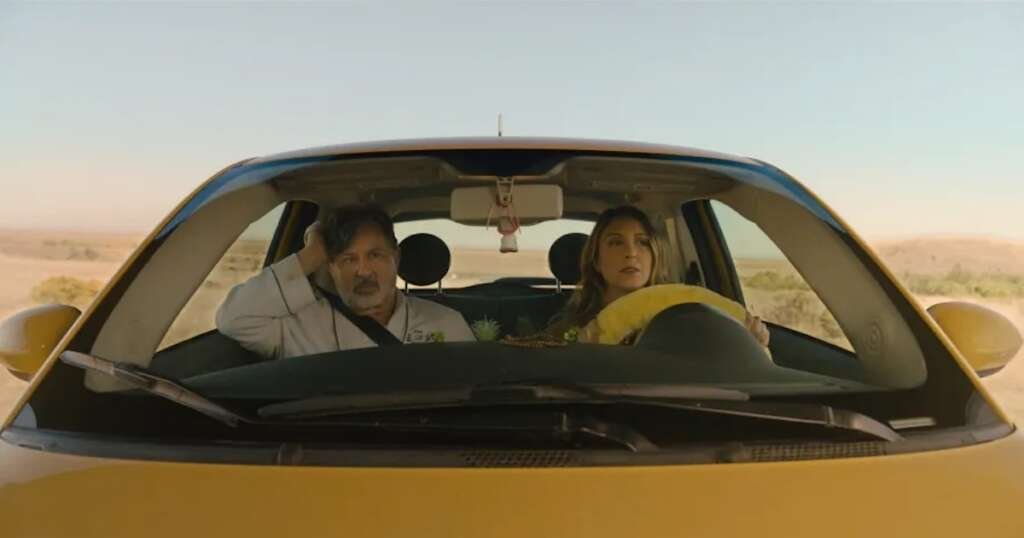
The director and star of 'Welcome to the Fishbowl' talk about a Denver-to-Telluride road trip and shooting a love letter to Colorado, ahead of the film’s Denver Film Festival screening Friday.
Glubok wrote and directed the film, which was shot across Colorado in September and October 2024 and stars Natalie Gold (Succession) and Jeremy Swift (Ted Lasso, Downton Abbey).
The film screens at the 49th Denver Film Festival at 7 p.m. Friday, Oct. 23, at MCA Denver at the Holiday Theater, with a Q&A to follow with Glubok, Gold, Swift and actor Marin Hinkle. OnScreen Colorado spoke with Glubok and Swift ahead of the screening about the real-life mountain scare behind the story, the pleasures of playing a rude and annoying character, and why the film had to be shot in Colorado.
This interview has been edited for length and clarity.
The film is about reaching an age where you wonder whether your shot has passed. Why was a screwball comedy the right way to tell that story?
Glubok: It came from a very real place. I had just turned 40, and we were headed to a friend’s 40th birthday party when I got stuck at the top of a mountain in Vermont. It was Sugarbush. I was genuinely afraid for my life, and it made me stop and ask, “Is this all there is?” I decided I was going to get down that mountain, and when I did, I resolved that I wasn’t done living. My dream was to be a writer-director, and here I was in my 40s with a husband I loved and young children, wondering whether I had missed my window. Nobody was asking about the script I’d been working on for so long. So instead of crying, I wanted to laugh. Screwball turned out to be the perfect vehicle for facing your mortality.
My co-writer, Donald Rae, who is very funny and very sharp, came to it from a similar place. He’s originally from Scotland and gave up a nearly 20-year career as a lawyer after having his own epiphany in his 40s. We bonded over that moment and made a comedy out of it.
When did you shoot, and how did Colorado treat you?
Glubok: We shot in September and October 2024. We got really lucky. There was one rainstorm in the first week, and then it didn’t rain for the rest of the shoot. We chose fall on purpose, because it’s beautiful and because the characters are in the fall of their lives.
Swift: It was great. The light is incredible. The landscapes and nature were unfamiliar to me, apart from maybe a few Westerns. It was the first time I’d seen a beaver dam outside a nature documentary. We shot some scenes in a log cabin, pretty high up, which was so evocative.
Your character is a long way from Higgins, the buttoned-down, proper Englishman many viewers know from Ted Lasso. What drew you to the role?
Swift: Exactly that. Storm is a multifaceted character, and it was a pleasure to play someone rude and annoying who doesn’t care. But there’s a journey to him that I didn’t fully appreciate until we were shooting. He’s in a crisis, seems to recover, then drops down again. We tend to think we’re getting better in a straight line, like a graph going up, but it’s one step forward, two steps back. I found that really interesting.
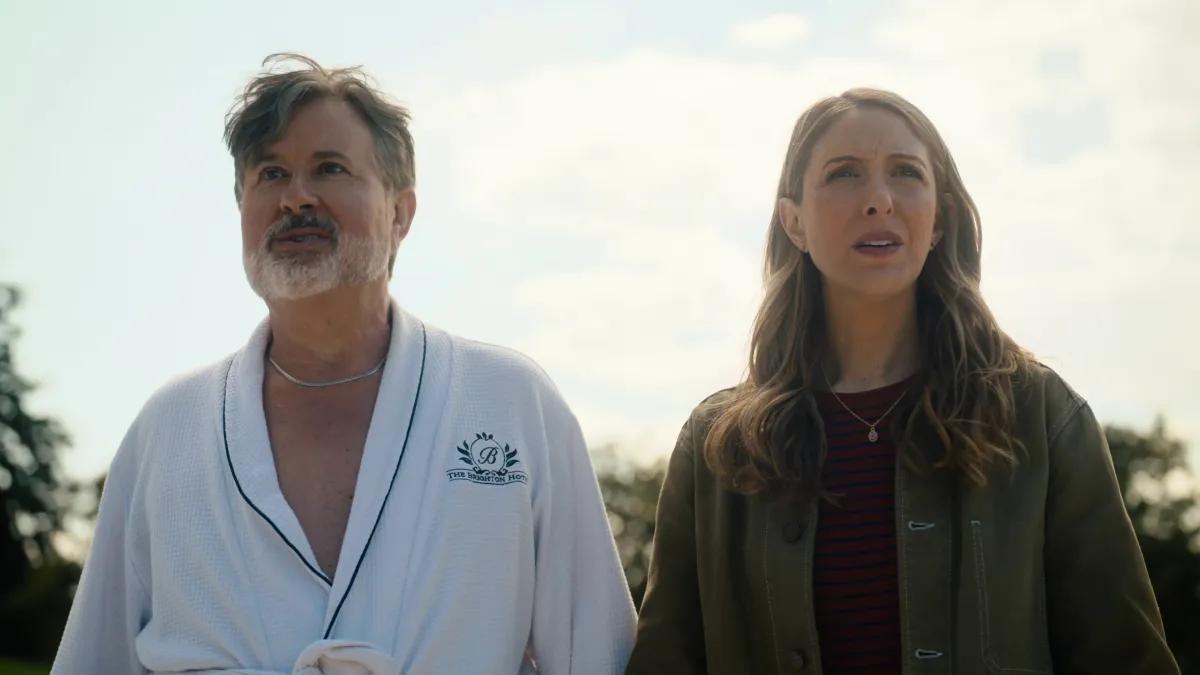
Jeremy Swift and Natalie Gold in ‘Welcome to the Fishbowl.’
Why did you want Jeremy for the part?
Glubok: He’s a comedic genius, and I loved him on Ted Lasso, but it wasn’t only that. His agent sent his reel, which was so diverse. He could play anything and was brilliant in all of it. This character has to be charming, relatable, annoying and confounding, all with a lot of charisma. He can’t just be a buffoon. I had a feeling he could do it better than anyone, and I was right.
The film pokes fun at the publishing world and its gatekeepers. How much is observation and how much is exaggeration?
Glubok: I did a creative writing MFA in fiction at Bennington, and I love literature. I thought for a while I would focus on prose, but I couldn’t put film down. I haven’t worked directly in publishing, but I’ve been around it, and I know a lot of writers. It’s really a stand-in for the in-crowd versus the out-crowd. I worked in Hollywood in the 1990s for some tough people, and there’s a lot of gatekeeping in every one of these little enclaves of creatives.
The two leads have some very physical, up-close scenes, including crawling over each other in a car. Did that require an intimacy coordinator?
Glubok: We had one for a specific scene with the Rope Lady, and it was non-negotiable for us. The intimacy coordinator also helped prepare the crew for some of the heavier subject matter in the film and was available as a resource. The stunt coordinator was just as important for the physical comedy.
Swift: Natalie and I tuned into each other so much. I could work with her forever. What I find funny, watching the film, is her processing the absolute guff my character speaks. She’s doing it for the audience. She’s truthful, funny and really moving.
Was there a scene where you couldn’t keep a straight face?
Swift: So often. In the jail cell scene, she knocks out the officer, he seems to be unconscious, and I say, “You killed him!” She just screamed in my face. I fell to the floor laughing. It’s one of the top five laughs of my life, and unfortunately it didn’t make the cut, probably because I laughed so much. We also riffed a lot in the process trailer. At one point she worried about whether the officer was all right, I said that if he’s injured, he’ll just need an amputation, and she shot back, “He hit his head!” That killed me. We had a lot of gems that didn’t make it into the film.
Many films shot in Colorado are all mountains and skiing. Why was it important to shoot this one here?
Glubok: It’s where I’m from and where I live. I’m a huge fan of the independent films of the 1980s and 1990s, and filmmakers like Jim Jarmusch, Alexander Payne and Jane Campion shot on location, which informs the whole ethos of a film. I worked on Sling Blade in the 1990s, shot in Arkansas in the hometown where my mother was from. Colorado is a character in this film. It’s a love letter to the state, because this is where I found my voice as a writer, director and filmmaker.
I’d originally conceived of the destination as Aspen, because of the Aspen Ideas Festival, where making it there means you’ve made it. But I realized you can’t really get lost driving from Denver to Aspen. Telluride is a journey. By the time you get there it’s otherworldly, and that mattered visually and for the storytelling. The mountaintop is a symbol, too. Elizabeth is so caught up in what other people think of her work that she’s forgotten she’s the one she has to please.
Jeremy, you came up in the theatre. Any plans to return to the stage?
Swift: Nothing has come along that has particularly interested me, but I’ve had some great experiences in theater. In my 20s I worked with a performance-art comedy group called The People Show, which played jazz and had amazing sets, and at the same time with the director Deborah Warner, who was very down on text. When you did Shakespeare with her, you had to do a table read putting it all in your own words, which was a real brain test. Those experiences inform everything, because in film you often don’t have the time or budget to rehearse, so you draw on your theatrical experience of how to approach a character and a text.
Complete the sentence: if you liked ___, you’ll like Welcome to the Fishbowl.
Glubok: Little Miss Sunshine, Sideways, David O. Russell’s Flirting with Disaster and Bringing Up Baby. People have also mentioned Midnight Run and Planes, Trains and Automobiles, which were my formative movies as a teenager in the 1980s. The very first screwball comedy was actually a road comedy, It Happened One Night, and we do a bit of an homage to those films, because screwball is a way to examine society through male-female dynamics. When I was building my director’s mood board, I couldn’t find a male-female road trip that didn’t end up romantic, so I think we’ve done something unusual.
The characters break a lot of rules without much consequence. Is that intentional?
Glubok: We do show consequences, in the credits. If you watch the credit sequence, which I highly recommend, the storytelling continues, including court orders keeping Storm away from the fountains in Denver parks. Test viewers actually asked about that, which I find interesting, that people care so much about fictional characters’ consequences. In our film, people should have consequences, and they do.
Anything else you’d like Colorado audiences to know?
Glubok: There are so many movies and TV shows set in Colorado that are shot in Canada, Kentucky, who knows where. Despite a lot of potential obstacles, we were determined to do it here. I think we show why Colorado is a special place, and we wanted to put it on the cinematic map.